
Successful AAC programming starts with one essential ingredient: personalization.
When an AAC device reflects a child’s real life—their interests, routines, and relationships—it becomes a tool for communication instead of just another piece of technology. That’s where an AAC Input Form makes a meaningful difference. In this blog post, I’m breaking down what an AAC Input form is, why it matters, and what information it should collect.
Why an AAC Input Form Matters in AAC Programming
AAC research shows that children engage more with communication systems when vocabulary is meaningful and motivating (Light, Drager, & Wilkinson, 2012). Incorporating a child’s preferences, favorite activities, and daily routines helps increase AAC use across settings. AAC abandonment rates increase as students get older. When the device becomes irrelevant for the child, including the visualization and customization of the system, their motivation to bring the device with them and use it decreases. Providers need to stay on top of changing preferences for a student in order to prevent this.
An AAC Input Form supports this process by gathering critical information from families and caregivers, ensuring that AAC devices are programmed with language that truly matters to the child.
What Should Be Included in an AAC Input Form?
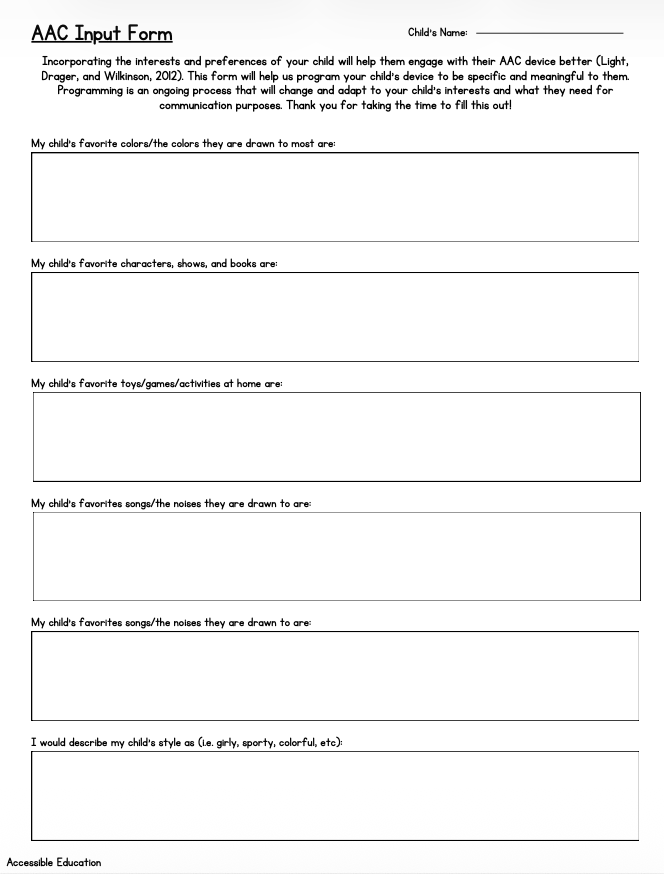
This form will guide families, speech language pathologists, and educators through key areas needed for effective AAC customization, including:
- Favorite colors and visual preferences
- Preferred characters, shows, and books
- Favorite toys, games, and activities
- Songs, sounds, and sensory interests
- Personal style and aesthetic preferences
- Names of meaningful people in the child’s life
- Frequently visited community locations
- Daily family routines and activities
- Common foods, drinks, and home environments
Each section is designed to provide actionable AAC programming data that can be immediately applied to an AAC system.
Who Should Use an AAC Input Form?
AAC input forms are ideal for:
- Speech-language pathologists (SLPs)
- Special education teachers
- AAC specialists
- Early intervention providers
- Related service providers
- Families and caregivers of AAC users
- AAC users! Let them have a say in their own system!
It works well during AAC evaluations, new device setup, device updates, and transitions between school years or service providers.
Strengthening Family Collaboration in AAC Services
Family input is a critical component of successful AAC implementation. Most devices come programmed out of the box using standard vocabulary assuming the student is white from a suburban middle class family. But what if your student’s family is from another country and eats a totally different cuisine? What if your student has very niche interests that aren’t preprogrammed? What if your student can’t talk about the people who are at home because they aren’t represented anywhere in the device? What if your student’s living environment isn’t represented anywhere in the device? Using an AAC Input Form for parents and caregivers helps bridge the gap between home and school by providing a structured way to share meaningful information to make sure you don’t forget any important details related to the child’s life.
AAC Programming Is an Ongoing Process
AAC needs change as children grow. Interests shift, routines evolve, and vocabulary requirements expand. If you are just setting up the device when it comes out of the box and never updating the vocabulary for the student, then it is very likely they will abandon the system. It is important that this form is revised and re-administered because students’ interests change from year to year, month to month, even week to week! You don’t want to leave your 16 year old AAC user with the ability to only talk about Mr. Potato Head and circle time- they need to have a system that reflects their current interests.I can’t tell you the number of times I’ve looked in the personal details section of an AAC device to find that the child’s age hasn’t been updated, their parents’ contact information isn’t up to date, and their address is wrong. In the same way that we need to keep this important safety information up to date, it is important that we make sure the device supports a student’s ability to talk about the things that matter most to them now.
A Practical AAC Resource That Supports Engagement
Sometimes the most effective AAC tools are simple, intentional, and easy to use.
If you’re looking for an AAC Input Form that helps personalize communication systems, increase engagement, and strengthen collaboration with families, I have a sample in my free resource library that you can download and send home today to start collaborating better with families and other team members. Have questions about how to use this with your student? Drop me an email!