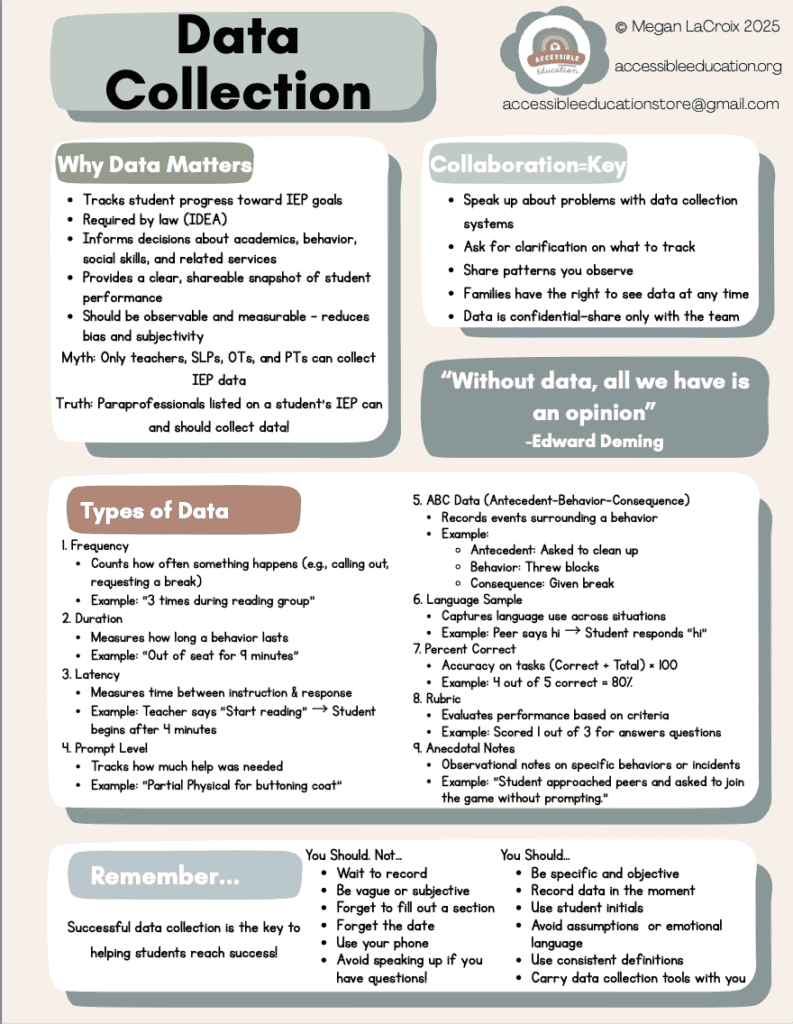
Training paraprofessionals is a huge part of your job as a special education teacher, so you already know this truth: Data collection doesn’t work unless your whole team is on board. You can design the most beautiful data sheets, align everything to IEP goals, and have a perfectly organized binder—but if your paraprofessionals aren’t confident in how to take data (or why it matters), it quickly falls apart. And to be fair, most paraprofessionals were never formally trained to do this!
So if you’ve ever found yourself:
- Re-explaining data systems multiple times
- Getting incomplete or inconsistent data
- Feeling like it’s “easier to just do it yourself”
You’re not alone.
The good news? With the right approach, you can teach your paraprofessionals to take accurate, consistent data—and actually reduce your workload.
Start With the “Why”
One of the biggest mistakes you could make is jumping straight into how to take data. I am so guilty of this, but I never regret stopping, slowing down, and explaining exactly why it is important to take quality data. If your team doesn’t understand why data matters, it will always feel like an extra task instead of a priority.
When training paraprofessionals, here are some ways you can explain the importance of data:
- Data helps us know if a student is making progress
- Data protects students by ensuring appropriate supports are in place and working
- Data informs IEP decisions and services
- Data helps us adjust instruction in real time
- Data collection is required by law
My advice would be to keep it simple and real. You could get very deep in the weeds about IDEA and Section 504 and the federal requirements for data collection, but often when we are training paraprofessionals, we have limited time to get everyone on the same page. A simple rationale will suffice if you are short on time.
Instead of: “Make sure you tally every instance of behavior.”
Try: “We’re tracking this so we can figure out what’s actually helping—and what’s not- for his team meeting.”
I’ve found over the years that when paraprofessionals understand the purpose of data collection, accuracy improves. Remind yourself of this the next time you think you don’t have enough time to explain the rationale behind the task you’re asking paraprofessionals to perform!
Define Exactly What to Track
Vague directions lead to inconsistent data. Every time. If you say, “I need you to track Megan’s behavior during recess,” you’ll likely get different interpretations of what Megan did and what was important to note during recess.
Instead, it is important to clearly define:
- What behavior looks like (observable, not subjective)
- When to record it
- What counts—and what doesn’t
- Where to record it
For example, let’s say you’re training a new paraprofessional on frequency behavior data. Instead of just telling them the list of behaviors you want them to tally during the day (let’s use “aggression” as an example), you should define this very specifically. Instead of saying “I want you to track Megan’s aggression”, tell them:
- Aggression looks like hitting with an open or closed hand, kicking with force, or throwing objects toward another person
- Demonstrate if you can what this looks like (visuals are helpful for adults, too!)
- Have the paraprofessional observe the student before asking them to take data so they know what to look for
- Model where and how to take the data (more on that later)
This clarity removes guesswork and builds confidence. I usually include this information on my data sheets as headers or footers so that there are built-in reminders for any paraprofessional working with your students. A behavior key is a must-have IMO!
Keep Data Systems Simple and Realistic
One of the fastest ways to lose paraprofessional buy-in is to create a system that doesn’t match the reality of the classroom. If staff are managing multiple students, supporting behavior, and running instruction, they need really simple data systems. Your paraprofessionals cannot stop every 10 seconds to write a detailed note.
When possible, make sure your data sheets are as streamlined as possible. Here are some ways I tighten what data collection looks like for my paraprofessionals:
- Use quick formats (tallies, checkmarks, + / -, abbreviations)
- Limit the number of targets being tracked at once
- Use time sampling if a behavior consistently occurs all day
- If possible, limit data to 1 page per day
It’s better to have simple, consistent data than complex data that never gets completed.
Model What Good Data Collection Looks Like
Telling someone how to take data is helpful. Showing them is what actually works.
When training paraprofessionals:
- Model taking data in real time
- Think out loud as you do it- this is my favorite strategy for training in the moment!
- Show what counts as a “yes,” “no,” or “prompted” response
- Demonstrate how to handle tricky situations
Let’s say, for example, you are training someone how to take task analysis data. BTW, if you are curious about the kinds of data sheets I use in my classroom, you can check that out here. Walk through the task with the student and model for the staff in real time how to collect data on what you’re doing. Narrate why you’re marking things the way you are, and explain your thought process. Be really specific- sometimes things are obvious to us and not clear to others.
Instead of: “After Megan does XYZ I’ll mark the data down on my data sheet.”
Try: “I’m marking what Megan just did there as prompted under this goal because I had to gesture before she responded. I am going to put a “P” next to that step of the task.”
This kind of modeling builds clarity quickly and reduces errors.
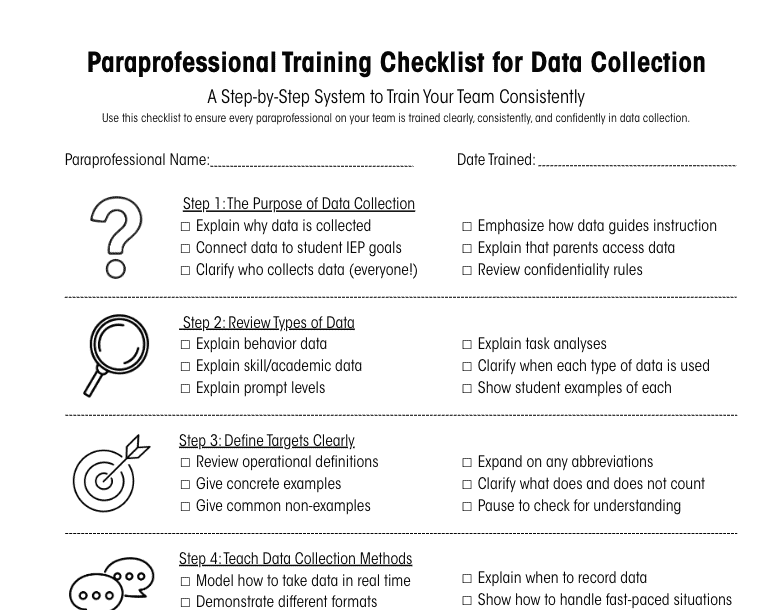
If this has you thinking
“This is exactly what my team struggles with…”
I put together a free Paraprofessional Data Collection Training Freebie you can use right away with your staff.
It includes a training checklist to maintain consistency and a cheat sheet to help reinforce your training.
Training Paraprofessionals Through Practice
We often expect paraprofessionals to implement systems independently after one explanation. But data collection is a skill—and it needs practice. We know that “I Do, We Do, You Do” is a powerful strategy for students, but it is also powerful as a paraprofessional training framework. Even if you only have a few minutes, a high-quality guided practice session can make a huge difference in accuracy.
We all know that the timing for training won’t be perfect every day, but when possible, keep to these guidelines for practice time:
- Practice during low-stress times- NOT during a behavior!
- Review sample scenarios together
- Compare data types and discuss differences and similarities
- Give immediate feedback
Instead of: Explaining how to use a data sheet once
Try: Explaining, demonstrating, and guided practice. Follow up a few minutes later, an hour later, or later in the day. Remind yourself to check in after a week- you want to catch any mistakes before too much time has passed.
Build Data Collection Into the Routine
If data collection feels like an “extra,” it won’t happen consistently. Instead, embed it into what staff are already doing. This could look like:
- Having data collection embedded into centers
- Putting visual prompts to collect data in different areas of your classroom
- Hanging data collection clipboards at the entrance of your classroom
- Using a stamp to add a quick frequency data spot onto a worksheet
- When designing materials, build in data collection sections to elimate the need for extra papers
For this to be effective, you need to set up data collection systems that are consistent and clear by:
- Noting when data needs to be taken each day
- Assigning clear roles (who tracks what)
- Keeping materials in the same place every time (and restocking frequently!)
- Use clipboards or digital tools that are easy to access, like QR codes or click counters
Give Feedback That’s Supportive (Not Critical)
If data isn’t being taken correctly, it’s usually a training issue—not a motivation issue. This is a good news/bad news situation- the bad news is you have something to fix, but the good news is improving accuracy is somewhat in your control! Feedback that shapes future behavior is crucial when training your paraprofessionals. We all want feedback that tells us we are doing a good job or that we need to adjust something. Even more important than remembering to give feedback is remembering to give supportive feedback. Being overly critical of your paraprofessional’s mistakes will breed defensiveness.
To avoid defensiveness, when giving feedback, you should:
- Be specific (“This was marked independent, but there was a verbal prompt so let’s write V”)
- Keep the tone supportive and positive- think growth mindset language
- Reinforce what they’re doing well
- Offer a clear correction
Instead of: “You’re doing this wrong. I already showed you how to do this.”
Try: “Let’s look at this one together—I would count this as prompted because I heard you give a verbal cue. Whenever we restate a direction, that counts as a verbal prompt. Let’s watch him do this again, and we can brainstorm what the next trial should be.”
Create Consistency Across Staff
One of the biggest barriers to reliable data is inconsistency between team members. I totally get how this happens- paras get onboarded at different times, and depending on the day, you may have been able to give one person 5 minutes of training and another 50. This is especially tricky when you rotate staff between students. However, you need to nip this quickly. If one person marks a response as independent and another marks it as prompted for the same student, for example, your data becomes difficult to interpret, and you won’t know what kind of progress the student is actually making.
To build consistency:
- Use clear definitions (when in doubt, spell it out on the data sheet!)
- Train all staff the same way (I’ve got a checklist to help you!)
- Review data together regularly
- Clarify expectations often
If you aren’t sure if you are training all staff the same way, I highly recommend sitting down to write out an onboarding checklist. This is a reference list for you to make sure all the key points of being a paraprofessional in your classroom are taught. This can be as specific or general as you’d like. This checklist will ensure you provide the same training to every paraprofessional you onboard. I have an example of one in my free resource library, which you can access by clicking below.
Make Data Review Part of Your Routine
Data collection should not end when the sheet is filled out. When paraprofessionals see that data is actually used, they’re more likely to take it seriously.
Build in time to:
- Review trends together
- Celebrate progress
- Problem-solve when things aren’t working
Even a quick weekly check-in can reinforce the importance of accurate data. I started doing this as an email (without including confidential student info) and got really positive feedback from the paraprofessionals I worked with. Remember, paraprofessionals sometimes never get to see the graphs of the data or hear about progress shared in meetings! As a valued member of the team, it is important to give them opportunities to see the data in action, too.
You Don’t Have to Train Your Paraprofessionals From Scratch
If you’re reading this and thinking, “This all makes sense, but I don’t have time to train everyone like this…” You’re not alone! Training paraprofessionals to take data effectively is one of the most important parts of running an effective classroom—but it’s also one of the most time-consuming.
That’s exactly why I created a video training designed specifically for paraprofessionals.
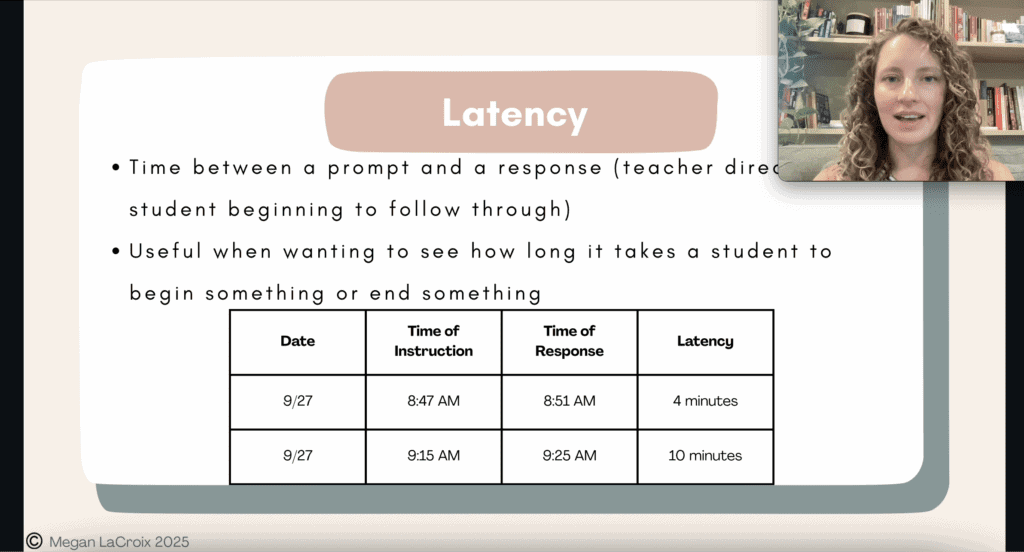
It walks them through:
- Why data matters
- How to take different types of data
- What accuracy actually looks like
- Common mistakes (and how to avoid them)
So instead of repeating the same explanations over and over, you can give your team a consistent, clear foundation—and spend your time supporting instruction instead. All you have to do is press play!
👉 If you want a ready-to-use training you can share with your staff, you can check it out here.
You’ll also get a handout to hand out to your paraprofesisonals to reinforce the topics covered in the training. I like to post it where data is frequently taken like academic tables or near circle time!